
JB.COM Terms of Service: What Every Player Should Know
Signing up for JB.COM isn’t just a formality – it means agreeing to a specific set of rules that shape how the platform runs and what’s expected from anyone using it. That agreement becomes binding the moment an account gets created and a player clicks “I Agree” during registration. From there, it covers a lot of ground: eligibility, KYC checks, how fairness gets certified, what triggers account termination, and more. Because these terms can change at any point, the only real way to stay on top of things is checking back every so often. Getting familiar with them before jumping into gameplay just makes for fewer surprises down the line. Take a look through the terms below and register knowing exactly what you’re signing up for.
Who Operates JB.COM and Under What License
Behind JB.COM sits Zozo Technology B.V., a company registered under Curaçao law with registration number 165255 and an office at Kaya Richard J. Beaujon z/n, Willemstad, Curaçao. The Curaçao Gaming Authority licenses and regulates the platform under License Number OGL/2024/1519/0809, and that licensing is really what gives the terms their legal weight in the first place. Since the relationship between player and operator falls under this jurisdiction, it’s not something that varies depending on where a player happens to be logging in from. Registering and accepting the terms isn’t a casual click-through either – it forms an actual legally binding relationship rather than just permission to browse a website.
Eligibility and Account Registration Rules
There’s a baseline set of conditions that need to be met before an account can even be opened. A few of the main ones:
- being at least 18 years old;
- providing information that’s accurate and current;
- accessing the platform from a jurisdiction where it’s actually allowed;
- agreeing to the Terms of Service, Privacy Policy, and Cookies Policy.
Only one account per user is allowed, and running multiple accounts counts as a breach, no exceptions. Registering doesn’t hand over any broad license to the platform, either – it’s a personal, non-exclusive right to use the service on your own device.
KYC Verification and Identity Checks
KYC documentation isn’t something reserved just for the moment of a first withdrawal – the operator can ask for it at any point to confirm who a user is and where they’re located. Until identity gets sufficiently established, service or payment processing can be held back, so dragging out document submission ends up affecting how usable the account actually is. This whole process ties back to regulatory obligations under the CGA license, and it’s applied the same way no matter what type of account is involved. Submitting inaccurate details during sign-up tends to backfire too, either slowing down verification or getting the account restricted outright.
Responsible Gambling and Account Restrictions
The terms don’t shy away from problem gambling – using the service requires not being diagnosed or classified as a compulsive or problem gambler. That said, the operator won’t be held responsible if problem gambling shows up during platform use, though it does commit to pointing users toward relevant help when it’s appropriate. Cool-off periods can also be put in place at the operator’s discretion whenever that seems like the right call for a specific account. All of this sits alongside the broader responsible gaming tools already available platform-wide, things like deposit limits and loss limits.
Breach of Terms and Account Termination on JB Casino
Breach any part of the agreement, even partially, and the operator has the right to respond however it sees fit. That could mean ending the agreement outright, terminating other agreements tied to that user, or pursuing legal action if the situation calls for it. A breach doesn’t need to be severe to trigger a response, which is exactly why staying within the terms matters more than it might seem. And closing an account doesn’t necessarily wipe the slate clean, either, since certain provisions can keep applying even afterward.
Fairness Certification and Game Integrity
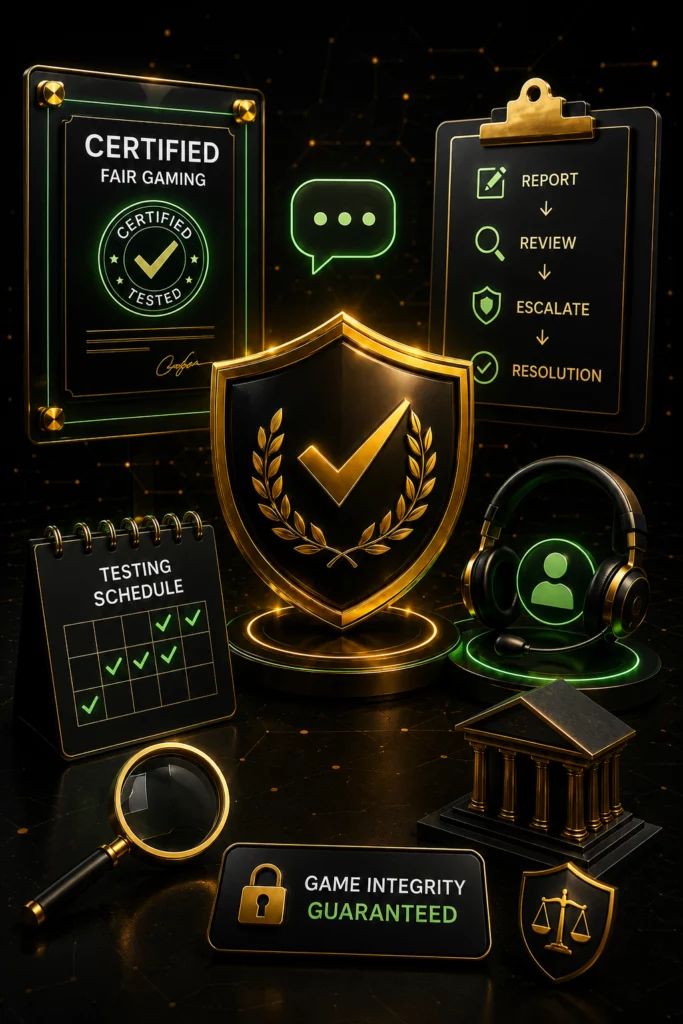
Keeping players in the loop about game fairness is something the operator takes seriously, and general details about the certification body used, along with how often testing happens, can be shared upon request. If a fairness concern comes up, it can go straight to support or get escalated to the compliance department for a closer look. Complaints get reviewed without much delay, and where it’s warranted, they get passed along to the relevant gaming control body too.
Live Chat Conduct on JB.COM
Live chat has its own rules, and breaking them can mean losing chat access entirely or having the account shut down, with the remaining balance refunded either way. That covers offensive language, harassment, defamatory comments, and using the chat as a promo channel for unrelated third-party sites. Statements meant to damage the platform’s reputation fall into the same category, as does using chat to push unlawful behavior. Anything that looks suspicious in there gets reported to the right authority when it needs to be.
Updates and Changes to the Agreement
Nothing stops the operator from updating or reworking the agreement whenever it’s necessary, including changes to the service itself, and none of that requires advance notice. Keep using the platform after an update goes live, and that’s treated as accepting whatever changed. That’s really the whole reason checking the current version now and then is worth doing – whatever’s in force at the time is what a player’s actually bound by.
FAQ
No, simply continuing to use the platform after an update is posted counts as accepting the revised version.
Yes, processing can be limited while identity verification is still in progress, regardless of whether a breach occurred.
Support handles it first, with the option to escalate to the compliance department if needed.
Yes, cool-off periods exist specifically for that, separate from a full account closure.
No, the remaining balance is refunded when termination happens specifically because of a live chat violation.